
–
Volunteering in Kaunas – help for Ukraine
We work in the basilica basement six days a week – join us too, on your own or with your group.
Volunteer week schedule
Use the arrows to move between weeks, and click an activity to add a reminder to your calendar.
Paraffin pouring happens at a different location and on different days — such a shift is marked in the schedule with its own address, and we announce it on Facebook as well. Mission departure days are not announced in advance for safety reasons.
Monday 5
Tuesday 6
Wednesday 7
Thursday 8
Friday 9
Saturday 10
Sunday 11
Closed
Click an activity in the schedule and you can add it to your own calendar once, or as a repeating entry.
Activities take place in the basement of the Basilica of the Resurrection of Christ, Žemaičių g. 31A, Kaunas unless the schedule says otherwise.
What happens in the basilica basement
Three main activities — none requires experience, we'll teach you everything on the spot. Just come.
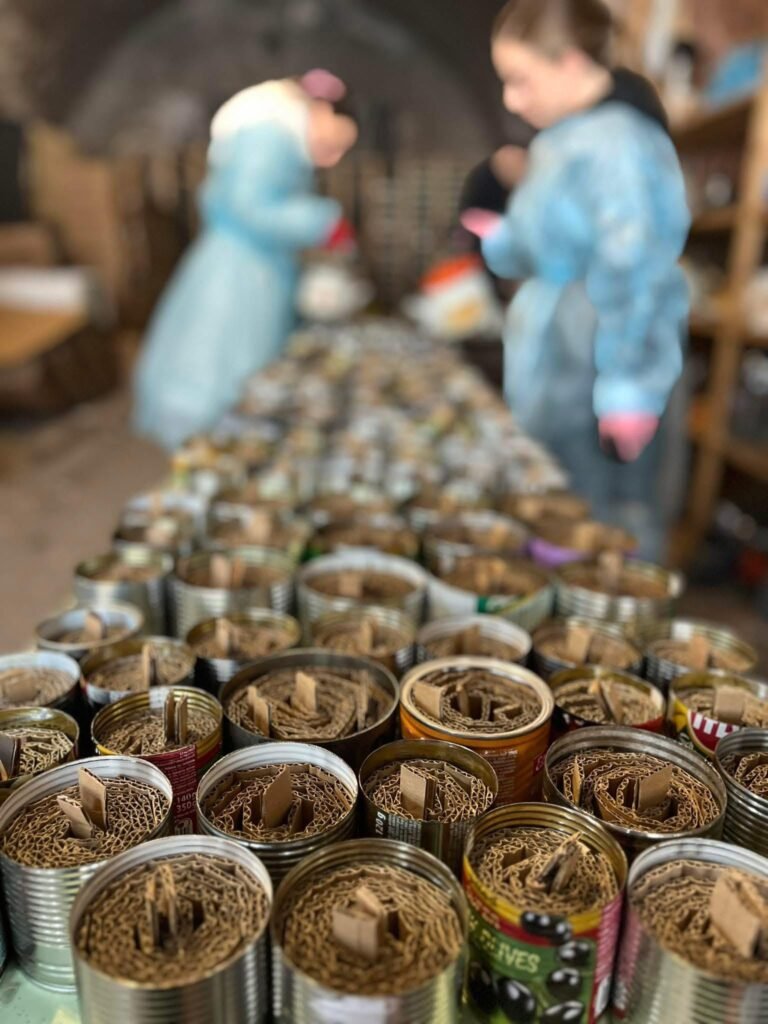
Candles
Trench candle production
1. Making the blanks — in the basilica basement
We usually don't buy tins — people bring them, and that's badly needed. We accept washed, label-free tins in the basement: tuna, pet food, and bigger ones too — canned beans and similar. Small ones are ready to use; the bigger ones we first cut down, and into each we coil cardboard — it works as a wick and extends the burn time.
Around the long table sit both school students and senior citizens: the work is quiet and monotonous, but without it there wouldn't be a single candle.
2. Pouring the paraffin — at a separate location
We pour the paraffin not in the basement but at a separate location — announced in advance in the schedule and on Facebook, with such shifts marked with their own address. The tins are filled in rows and left to set: 1 kg of paraffin makes 4 candles; the small one burns 3–4 hours in a trench, the bigger one 8–10.
On an average pouring weekend we fill about 4,000 candles, and the single-shift record is 5,635. Paraffin is just about the only thing in the whole candle process that has to be bought: a tonne costs €800–1,200. That's why money donated here goes straight into paraffin.
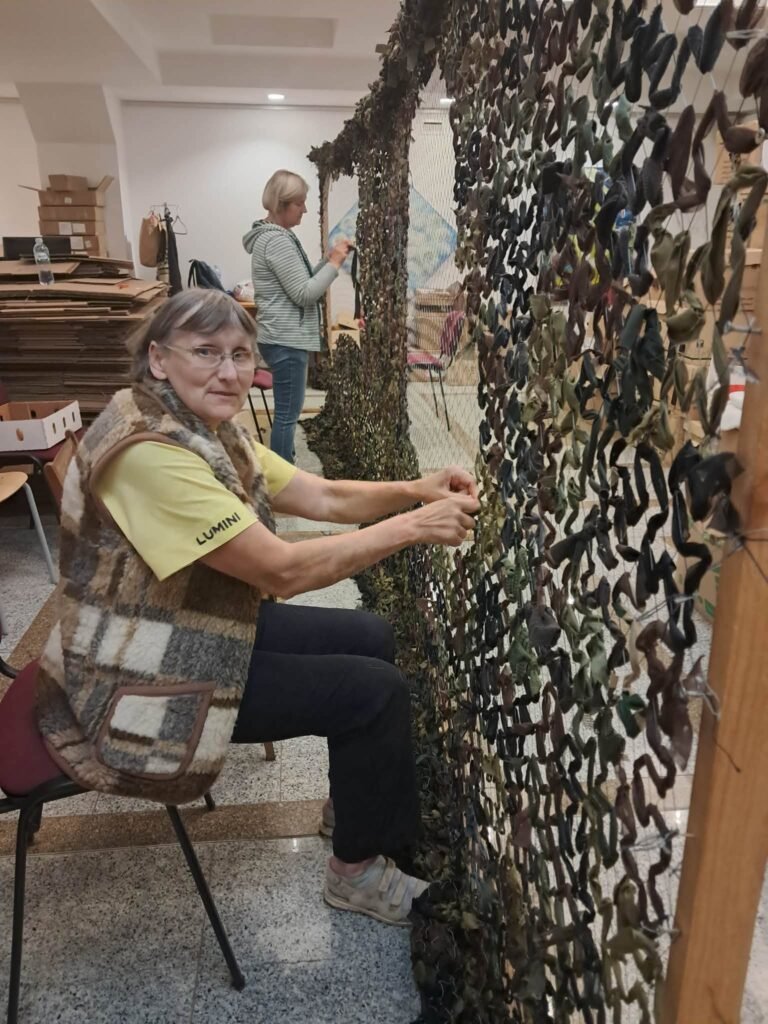
Nets
Camouflage net weaving
A net is woven by people sitting around a taut base: strips of fabric are worked into the mesh until no see-through gaps are left. One net takes eight hours and 6–8 volunteers weaving together, so this is not a half-hour job but a whole shift.
We choose colours by season: greenish-brown nets are woven for the warm season, white or grey for winter, to blend with the surroundings. Whether a drone spots a position, a vehicle or equipment depends directly on that.
Anyone can weave — no experience needed, we'll show and teach you on the spot. The work is done sitting around the net; individuals come, and so do families, school classes and company teams.
Fabric for the nets is usually brought by people and companies — we hardly ever have to buy it. What we need is hands.
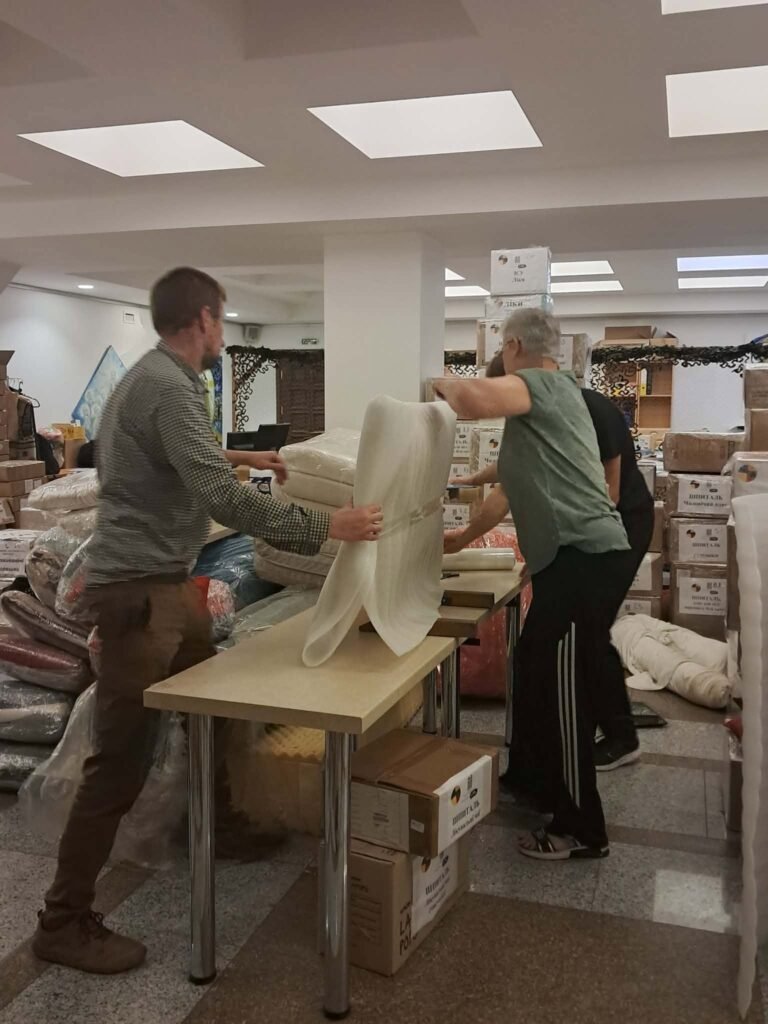
Humanitarian aid
Preparing humanitarian aid for the missions
Aid arrives at the basement every day: a few boxes from a school, a full car boot, sometimes an entire minibus. The people who bring it usually help unload it, so the volunteers' work starts with sorting — medicines and dressings, hygiene and nursing supplies, bedding, men's clothing for the wounded, walkers and crutches, sleeping bags, torches with batteries, tools, long-life food, pet food, electronics.
We pack the sorted goods into boxes and write on each one what's inside — the contents label makes the box easier for customs at the border to check, and quicker for the recipients in Ukraine to search through. We weigh the boxes and draw up content lists for customs documents: without a proper list, the shipment won't cross the border. We don't collect items that aren't on the needed-items list — there's always less room in the vehicle than we'd like.
Shipments go to all kinds of recipients — soldiers, hospitals, sometimes even animal shelters. Loading the vehicles is done by everyone who's in the basement that evening; from there it's the drivers' route and their responsibility. We don't announce departure days in advance: that's a safety matter for both the drivers and the cargo.
Not everything arrives as donations — very specific requests come from the front too, from power banks to generators. Those things, like the vehicles, their repairs and fuel for missions, we buy with the money donated.

Trench-candle production and camouflage-net weaving are co-funded by the Lithuanian Ministry of National Defence under the project “Laisvės ugnis” (Fire of Freedom).
For school students we sign off their mandatory community service hours — for taking part in any of the three activities.
Stand together with us
Come to the basilica basement any day except Sunday during the listed hours — only paraffin pouring happens at a different address, which you'll find in the schedule. For a group, company or school visit, let's arrange in advance.
Can't volunteer? Help another way
Bring in tins for trench candles, or support us financially — donations buy paraffin, vehicles, their repairs, fuel for missions and whatever the soldiers themselves ask for. You can support us by bank transfer or by assigning 1.2 % of your income tax.