
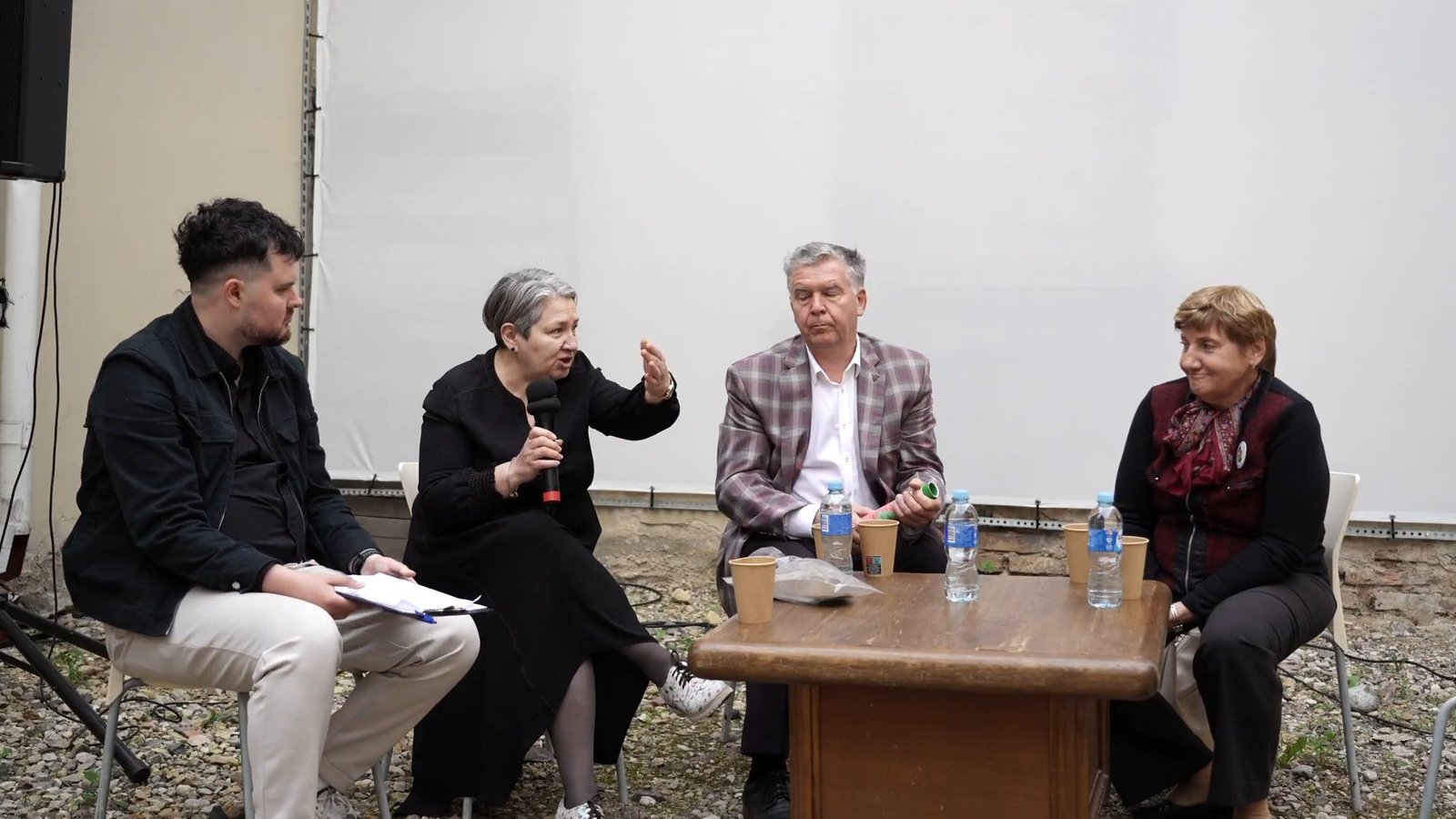
“The Path of Freedom: from the Baltic to the Black Sea” – Tatjana Narkevičienė at a Vilnius discussion
On the evening of 27 August, in the courtyard at Totorių g. 9 / Labdarių g. 10 in Vilnius, where the Vytautas the Great War Museum is building its Centre for the Study of Lithuania’s Freedom Struggles, a discussion took place under the title “The Path of Freedom: from the Baltic to the Black Sea”. The place was cherished by Albinas Kentra: the former home of the Forest Brothers society, which the museum is turning into a new historical space; for now its events happen in the open-air courtyard. At the table sat military historian and MP Prof. Valdas Rakutis, MP and former Minister of National Defence Dovilė Šakalienė, Angonita Rupšytė, one of the organisers of the Baltic Way, and one of our fund’s founders and its current head, volunteer Tatjana Narkevičienė. The museum’s historian Leonardas Augustis moderated.
For an hour and a half the panel traced the winding road of the Baltic states to freedom in the 20th century and its culmination in the Baltic Way of 23 August 1989, then turned to historical memory, regional cooperation and today’s threats, returning again and again to Ukraine, which is fighting for our freedom and yours. Rupšytė called the Baltic Way “a citizens’ referendum on restoring Lithuania’s independence” and said people will only join such a chain again for one goal: keeping it. Šakalienė noted that Ukraine is fighting alone today, that our NATO membership “is why the bombs are not falling on us”, and that the hardest job now is our society’s own unity. Rakutis recalled the interwar lesson: “We had no friends, only a great many enemies.” The discussion came three days after the Independence Day commemoration in Kaunas that we wrote about. Below is what Tatjana said, lightly condensed from speech.
“Visi išvien” is not just a name
Asked about regional solidarity and the fund’s name, Tatjana started with where it comes from:
“Our fund’s name is no accident, and not only because it calls for unity. We work at Christ’s Resurrection Basilica in Kaunas, and the name is tied to Saint Josaphat. On his icon, in Ruthenian, it says ‘Da vsi jedino budut’ – that they all may be one. That is our fund’s credo: that we all be together, as one.”
She also recalled Ecumenical Patriarch Bartholomew, who in March 2023 asked the Lithuanian Seimas for help in standing firm against centuries of pressure from the east and a church used for political ends. “Our name is not for nothing. With God’s help we try to unite and to fight the communists. And we keep coming back to the same thing – there is no getting away from it.”
“I was born into a family of deportees; I was born and grew up in russia. I know like no one else what that community is, what they are prepared to do and what they are capable of. And this work at the fund genuinely calms me. I try to fall asleep with the thought that what I could do today, I did. Otherwise it is hard.”
That this is not a war between two states alone she knows from experience: she was on the Maidan in 2014, and Bernardinai wrote about that expedition at the time.
“This is not only russia’s war against Ukraine. Truly not. It is the fight of God’s children, God’s people, for the right to live honestly and beautifully, with God – against the remnants of that Soviet communist order. They will not leave us in peace; they do not let us live and they will not. So there is only one option: to fight them to the last breath.”
Žalgiris, 1991 and a winning ticket
Tatjana came to Lithuania in 1991, aged 21. “My daughter told me: the best thing you ever did was leave russia. I gave my children the hope of living honestly and humanly.” What helped her decide which way to go were, in her words, the indescribably emotional battles between Kaunas Žalgiris and CSKA Moscow:
“At least those five could give the russian army a proper punch in the face. And here is something I still cannot explain: my father, a military man of very high rank, God rest him, supported Žalgiris – there was something so incredibly charismatic and captivating in it. I am very grateful to Sabonis, Kurtinaitis, Chomičius and Čivilis. The arena was the one place where you could shout ‘Lietuva!’ without restraint – and everyone added in their heads: ‘will be free’. Even the fans in Moscow knew that by then.”
The Baltic Way itself she knows only from photographs, but the feeling, she says, is unrepeatable, and she felt the same one on the Maidan, “when people fight desperately, with their last strength, as if for air”. Kaunas did not win her over immediately either:
“I came to Lithuania in ’91, and Kaunas seemed such a Lithuanian place. What unsettled me most, like a pain through the body, was when someone said ‘it was better under the russians’. I wanted to hide. I would say: Magadan must have been really lovely, then.”
Today, she says, we have to admit that we have relaxed a great deal, and that we live very well:
“The Baltic Way is not only a symbol. It is a road that people chose. It is not enough to come and stand there on the day; you have to walk that road through your life. We really do live very well, and we have the means to share. I always say: go through your home, look at what you no longer need – Ukrainians will find a use for a lot of it. And that I have lived in Lithuania since 1991 is a kind of luck. As if I had won the lottery – a winning ticket. Thank God for that.”
“Ukraine wanted to take the Baltic Way, and it was not allowed to”
In her closing words Tatjana reminded the audience where russia’s assault began: in November 2013 in Vilnius, when Viktor Yanukovych refused to sign Ukraine’s association agreement with the European Union.
“That is a very clear sign that Ukraine wanted to take the Baltic Way, and it was not allowed to. That is the whole connection: it is a road into the light, a road to freedom from every kind of dependence – only then are you truly independent. Nothing is impossible for God. Let us pray – we began our work with prayer. Then we understood that Ukrainians need their daily bread every day. They ask, and we are the hands that can give and that do give. So we walk that Baltic Way hand in hand, as far as possible from those who stayed behind in the east. And by now it is not even walking – you have to run, without looking back. Very painful things; there is not always a solution – you sit down and pray: ‘God, give me health and wisdom.’ That is all.”
“A man died for Ukraine, and there was no Ukrainian anthem”
As the discussion drew to a close, a volunteer in the audience who has driven aid to Ukraine dozens of times spoke about Lithuanians killed in Ukraine being buried “carelessly, almost in secret, not at state level”, and about how much harder it has become to ask for support. Tatjana added a memory of March 2024, when Tadas Tumas, the first Lithuanian killed in the war in Ukraine, was buried at Antakalnis cemetery:
“When we buried Tadas Tumas, I thought all of Vilnius would come. And the hardest thing was to grasp how few of us there are: we stood at the grave and looked around – we all know each other, especially those who have been volunteering since 2014. Everything went by protocol; they played the Lithuanian anthem. A man died for Ukraine – and there was no Ukrainian anthem. I look at the men and they say: ‘You know it, start.’ The tears just stand there.”
“We have to understand that there are not many of us. Every day, when you get up, you have to make yourself think what you can do today so that at least one more person comes round. Raising support is brutally hard, but I am not asking for myself. I say: I have very pretty eyes – give, because it is not for me. I have not needed anything for a long time. Giving up would be easy. We have been given the hardest level.”
And on whether an attack on us is realistic: “The Ukrainians won eight years – then the big war began. I was the greatest pessimist, but that Iskanders would pound Kyiv – nobody’s imagination stretched that far. Scare or no scare, they attack, and they will. It is a question of time. The point of this discussion: go home and think it over. And the Baltic Way markers are signs so that we do not lose the road. We have clearly wandered off somewhere; we need to come back and get to work.”
The full recording
The museum has published the full hour and a half. Tatjana speaks at 17:56 (the fund’s name, the Maidan), 45:15 (Žalgiris and 1991), 60:55 (the Baltic Way as a choice), 77:21 (closing words) and 88:22 (the funeral of Tadas Tumas). The discussion is in Lithuanian. Recording: Vytautas the Great War Museum.
Join in
“We are the hands that can give and that do give” – those hands can be yours too. Monthly or one-off support becomes paraffin for trench candles, fuel and vehicles for Ukraine’s defenders, and a couple of free hours become a shift in the basilica’s basement: the volunteer schedule is here. And go through your home – here is what is needed most.
Da vsi jedino budut – that they all may be one. All together. 🇱🇹🇺🇦
Sources: the Vytautas the Great War Museum’s announcement; the recording of the discussion (YouTube); LRT on the funeral of Tadas Tumas (16 March 2024); the Centre for the Study of Lithuania’s Freedom Struggles.
Support Ukraine
Donations buy paraffin, fuel, vehicles and whatever Ukrainians themselves ask for.
Donate nowLT05 7044 0901 1228 8322
More news
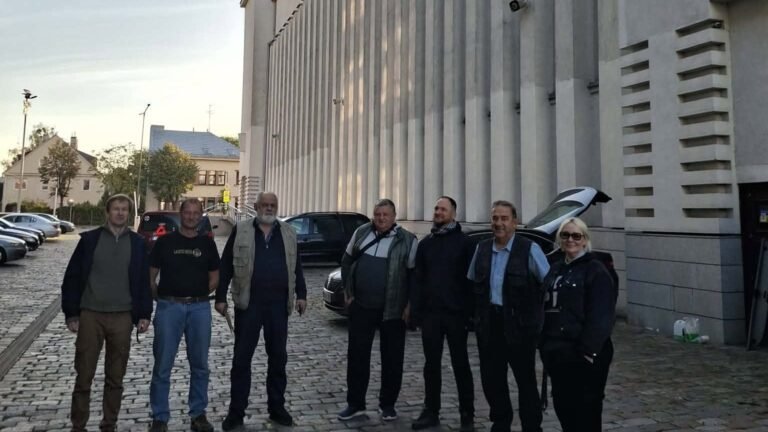
The car that saved Ukraine’s defenders: the mission “Pokrova” report
The mission “Pokrova” is complete: 14,168 kg of humanitarian aid, 43 loadings, 17 vehicles left in Ukraine. One of them stopped the…
Read more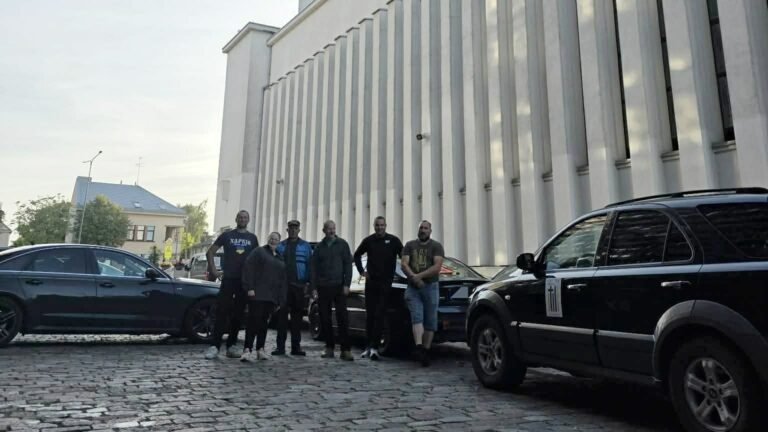
Seven vehicles left for Ukraine: the mission “Pokrova” continues
On 8 September seven vehicles and a trailer of tyres left the Christ’s Resurrection Basilica in Kaunas for Ukraine. A second run…
Read more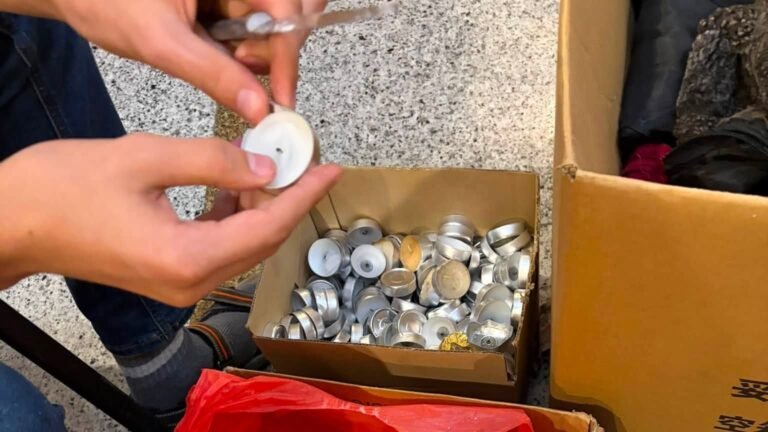
Trench-candle season begins: from 7 September we also work on Saturdays
Trench-candle season in the basement of the Kaunas Christ’s Resurrection Basilica: from 7 September we also work on Saturdays – Mon–Fri 5–8…
Read more